What You’ll Gain from This Blog
- Know which everyday actions are illegal or restricted in Singapore, even if they seem harmless elsewhere
- How tourists can avoid unnecessary fines and penalties
- Differentiate between myths and real enforced laws to live smartly in Singapore
- Understanding the local laws can help you navigate Singapore confidently and seamlessly
Singapore is widely admired for being one of the cleanest, safest, and most efficiently run countries in the world. That reputation doesn’t happen by accident—it’s supported by strict public laws that prioritise order, hygiene, and safety.
For tourists and business travellers, however, some everyday actions that seem completely harmless elsewhere can unexpectedly lead to fines in Singapore. Most people who get penalised aren’t being reckless; they’re simply unaware of local rules.
This guide walks you through 10 real and enforced laws in Singapore that tourists should know, helping you avoid unnecessary trouble, separate myths from facts, and enjoy a smooth, stress-free stay.
Quick Snapshot: Weird Singapore Laws Tourists Should Know
- Eating or drinking on public buses – ❌ Illegal
- Accessing computer systems or data without authorisation – ❌ Illegal
- Feeding wildlife without approval – ❌ Illegal
- Not flushing public toilets – ⚠️ Remove this claim unless verified
- Smoking in prohibited places – ❌ Restricted
- Appearing nude in public view, including from a private place – ❌ Illegal
- Littering – ❌ Fines and possible corrective work orders
- Importing ordinary chewing gum – ❌ Generally prohibited, with specified exceptions
- Public spitting and late-night alcohol consumption – ❌ Restricted by law
- Crossing roads in breach of pedestrian rules – ❌ Can attract fines
10 Strange Laws in Singapore Tourists Should Know to Stay Out of Trouble
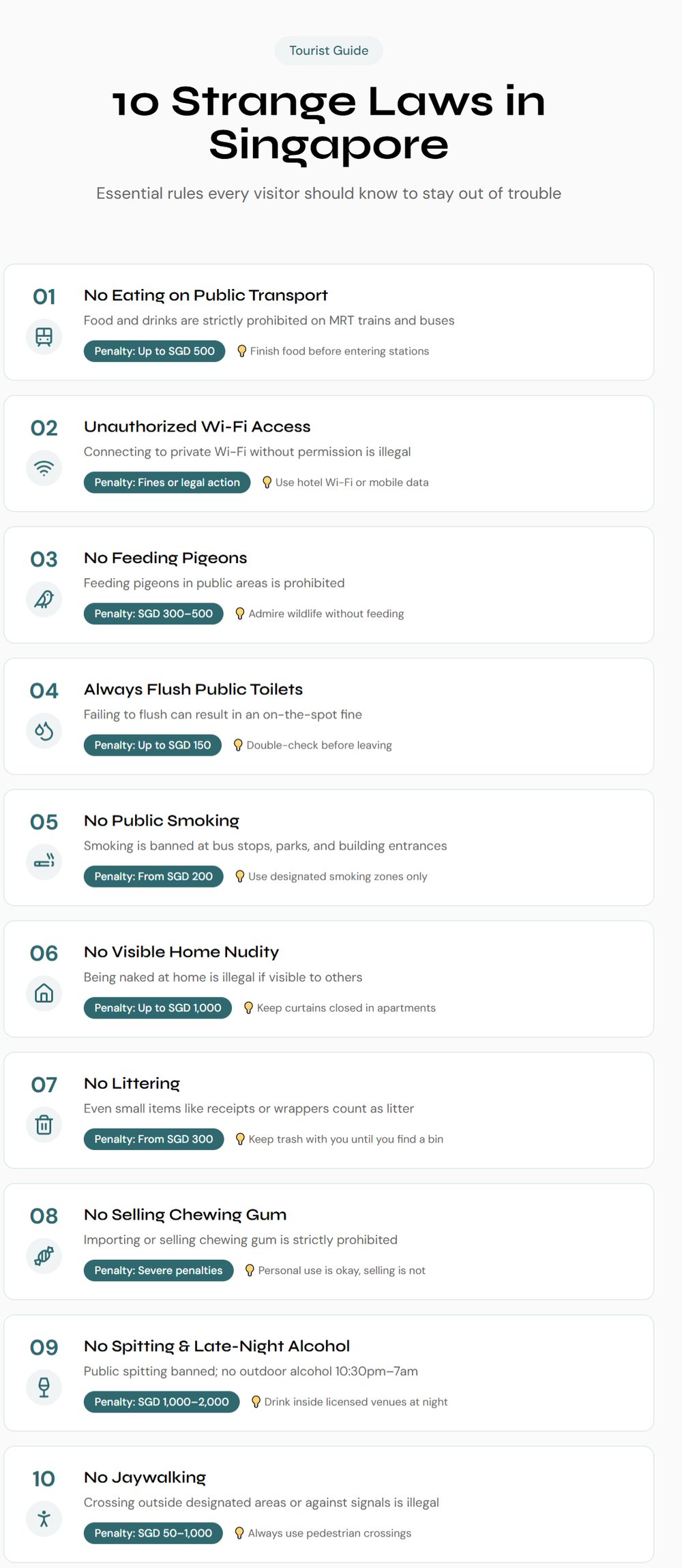
1. Eating/drinking on Public Transport
Singapore has strict rules against eating and drinking on public transport. Eating and drinking are prohibited on MRT trains and within the rail system, and passengers are also prohibited from consuming food or drinks on public buses.
Since 23 September 2026, eating or drinking on public buses can result in a fine of up to SGD 500. This rule also covers chewing gum on public buses.
To avoid penalties, finish your food and drinks before boarding and follow the rules displayed at stations and on public transport.
Why this law exists:
To maintain cleanliness and prevent pest issues in enclosed public spaces.
Penalty:
Fines can go up to SGD 500.
Tip:
To avoid penalties, finish your food and drinks before boarding and follow the rules displayed at stations and on public transport, and keep bottles sealed while commuting.
2. Using Someone’s Wi-Fi without Permission
Singapore’s Computer Misuse Act criminalises unauthorised access to computer programs or data. However, connecting to an unsecured Wi-Fi network is not automatically the same as committing this offence; the circumstances and whether access was authorised matter.
Why this law exists:
To protect digital privacy and prevent misuse of networks.
Penalty:
For a first conviction under Section 3, the maximum penalty is a fine of SGD 5,000, imprisonment for up to two years, or both. Higher penalties apply to repeat offences and certain cases involving damage.
Tip:
Use hotel Wi-Fi, official public hotspots, or your own mobile data.
3. Feeding pigeons
Singapore prohibits intentionally feeding wildlife without written approval from the relevant authority. The rule applies to wildlife generally, not just pigeons.
Why this law exists:
To prevent overpopulation and maintain hygiene in public spaces.
Penalty:
From 1 July 2026, a first conviction can attract a fine of up to SGD 10,000. A second or subsequent conviction can attract a fine of up to SGD 20,000, imprisonment for up to 12 months, or both.
Tip:
As tempting as it may be, admire wildlife without feeding them.
4. Vaping in Singapore
Vaping is illegal in Singapore. The law prohibits the possession, purchase and use of e-cigarettes and vaporisers, and bringing these devices into Singapore is also prohibited. Tourists should not assume that carrying a vape for personal use is permitted.
Why this law exists:
Singapore restricts vaporisers to address public-health concerns and prevent the use and distribution of prohibited products.
Penalty:
Since 1 May 2026, individuals caught possessing, purchasing or using vaporisers can face a fine of up to SGD 10,000. Importing or supplying vaporisers carries substantially more severe penalties, including imprisonment and significant fines.
Tip:
Do not pack a vape or its components in your luggage when travelling to Singapore. Check the latest official guidance before departure.
5. Smoking in Public Places
Smoking is prohibited in many public premises in Singapore, which include bus stops, covered walkways, parks, and building entrances.
Why this law exists:
To protect public health and keep shared spaces clean.
Penalty:
A person caught smoking in a prohibited place may receive a composition fine of SGD 200. If convicted in court, the fine can be up to SGD 1,000. Smoking restrictions apply to specified indoor and outdoor locations, not every public place.
Tip:
Look for clearly marked designated smoking zones.
You can also opt for our serviced apartments in Singapore that offer designated smoking areas and other luxurious amenities for a perfect combination of space, flexibility, privacy and comfort.
Strange Laws in Singapore

6. Being Naked at Home When You're Visible to Others
Singapore law prohibits appearing nude in a public place or in a private place when exposed to public view. This does not mean that being nude inside your home is automatically an offence; exposure to public view is the relevant distinction.
Why this law exists:
To prevent public nuisance and indecent exposure.
Penalty:
On conviction, the maximum penalty is a fine of SGD 2,000, imprisonment for up to three months, or both.
Tip:
Keep curtains closed, especially in high-rise apartments.
7. Littering in Singapore
Littering in Singapore is an extremely serious matter. This includes even small items, like throwing cigarette butts, receipts, food wrappers, etc.
Why this law exists:
This strict enforcement is one of the reasons Singapore is exceptionally clean.
Penalty:
The maximum court fine is SGD 2,000 for a first conviction, SGD 4,000 for a second conviction, and SGD 10,000 for a third or subsequent conviction. A court may also impose a Corrective Work Order requiring the offender to clean a public area for up to 12 hours.
Tip:
If you don’t see a bin, keep the waste with you until you find one.
8. Bringing or selling chewing gum
Singapore generally prohibits the import of chewing gum, except for specified Health Sciences Authority-approved oral dental and medicinal gum. The import restriction is different from saying that all chewing gum is illegal to possess or chew.
Why this law exists:
To prevent vandalism and cleanliness issues.
Penalty:
The applicable consequences depend on the specific import or sale offence. Avoid quoting a single penalty without verifying the relevant provision.
Tip:
Tourists should not assume that ordinary chewing gum is allowed in their luggage for personal use. Check the latest Singapore Customs guidance before travelling.
9. Public Spitting and alcohol consumption at night
When in Singapore, remember that spitting in public places such as sidewalks, markets, and public buildings is prohibited and can lead to fines up to SGD 1,000.
Additionally, one can not consume alcohol in public places between 10:30 pm and 7:00 am.
Why these laws exist:
To maintain hygiene and public order, especially at night.
Penalty:
For the relevant public-spitting offence under Section 11 of the Miscellaneous Offences (Public Order and Nuisance) Act, the maximum fine on conviction is SGD 1,000, rising to SGD 2,000 for a repeat conviction under that provision. Alcohol-related penalties depend on the applicable offence and circumstances; do not present the spitting penalties as applying to both offences.
Tip:
Enjoy alcohol inside licensed venues and avoid drinking outdoors late at night. The alcohol restriction between 10:30 pm and 7 am remains broadly correct for public places, with additional restrictions in designated Liquor Control Zones.
10. Jaywalking
Jaywalking outside the designated pedestrian crossings or against traffic signals is illegal.
Why this law exists:
To ensure pedestrian safety and smooth traffic flow.
Penalty:
Penalties depend on the specific pedestrian traffic rule breached. Under Section 121 of the Road Traffic Act, the maximum fine on conviction for a pedestrian who breaches applicable crossing rules is SGD 100. The higher penalties in that section apply to drivers, not pedestrians.
Tip:
Always follow pedestrian lights, even if the road looks empty.

Final Thoughts
Singapore can be tough to navigate for newcomers, but these rules should be taken as the reason behind this gorgeous city’s clean and safe reputation. Most tourists face fines unintentionally, simply because they are not aware of these rules.
By knowing these rules, you can make your stay in Singapore seamless and easy to navigate. Furthermore, selecting the right accommodation in Singapore that is rule-compliant can make your stay smoother from the outset.
FAQs
What are the strictest laws in Singapore that tourists should know about?
Is chewing gum illegal in Singapore, and can tourists bring it?
Can you eat or drink on Singapore’s MRT or public buses?
Is spitting in public illegal in Singapore?
Can tourists be fined for jaywalking in Singapore?
Can I bring a vape or e-cigarette into Singapore?
Can you drink alcohol in public in Singapore after 10:30 pm?
Can tourists smoke anywhere in Singapore?
Is it illegal to walk naked inside your own home in Singapore?