
What You’ll Gain From This Blog
- Understand what a Bail Mobilité in Paris is and who qualifies.
- Learn the key rules on lease length, deposits, notice and rent.
- Know which documents and guarantees you may need.
- Compare Bail Mobilité, serviced apartments and other rentals.
- Avoid common mistakes when renting temporarily in Paris.
- Use a practical checklist before signing your lease.
As you look for a furnished apartment in Paris for 1-10 months, it becomes clear that renting temporarily isn’t quite as simple as finding an apartment and agreeing on a monthly price. A conventional residential lease is designed around longer-term housing.
But when you’re a student, intern, or professional on a temporary assignment, you do not want to pay extra charges of normal leases. The Bail Mobilité (mobility lease) comes here and provides an efficient route, provided you qualify. It’s a written, time-bound contract for furnished homes that gives tenants one month’s notice and prohibits security deposits, while giving landlords a clear framework for short-term rentals.
This guide explains what Bail Mobilité is, who it’s for, and when it makes sense versus serviced apartments or standard leases.
Why Bail Mobilité exists and why it matters if you're temporarily renting in Paris
Renting temporarily in Paris isn’t quite as simple as finding an apartment and agreeing on a monthly price. Since residential leases are designed around long-term renting, it does not work as a temporary rental. Holiday stays also do not work here.
But there is a large group of people in between: students arriving for a semester, professionals coming to Paris for a temporary assignment, interns, people undertaking training, and employees relocating before they find a permanent home.
Bail Mobilité Paris was created for this kind of temporary housing need. It provides a specific framework for furnished accommodation for people in qualifying situations, with a contract that can run from one to 10 months. The tenant does not have to commit to a conventional long-term furnished lease, while the landlord has a defined framework for renting the property temporarily.
But there is an important distinction that is easy to miss: Bail Mobilité is not simply “a rental for less than a year.” Your reason for staying matters as much as the length of your stay and is also a main qualification for the same.
A professional coming to Paris for a temporary work assignment may qualify for a Bail Mobilité, not someone visiting the city purely for a holiday.
So, what exactly is a Bail Mobilité?

Bail Mobilité is a furnished-rental contract introduced under France's ELAN housing law in late 2018. It's signed between a landlord (or their agent) and a tenant recognised as a temporary occupant, for a fixed term of one to ten months.
Core parameters of a Paris mobility lease to keep in mind:
- It doesn't renew itself. The term can be adjusted once, by amendment, but the total can never exceed ten months. Want to stay longer? You and the landlord move onto a standard lease, and the Bail Mobilité simply ends.
- No security deposit, ever. Landlords are legally barred from requesting one. A guarantor can be requested instead.
- You can leave early. Tenants can end the lease at any point with one month's written notice. Landlords, in turn, don't have to give notice when the fixed term simply expires.
- The property must meet a furnished-rental minimum. French law specifies clearly what furniture and equipment a property legally needs to be considered furnished. This includes bedding, kitchen appliances, storage, table and seating, cleaning equipment, and more.
The only exception. A housing-simplification law passed in late November 2025 introduces a new Bail Mobilité variant for properties inside dedicated "employment-purpose residences," with terms as short as one week and as long as eighteen months. It isn't in force yet; an implementing decree is still pending. So for now, the standard one-to-ten-month rule is what you'll actually encounter.
For the exact legal wording and mandatory clauses, see the official rules here.
Who is it actually for?
This is where a lot of renters, particularly those arriving from abroad, get confused. The Bail Mobility lease isn't available to anyone seeking furnished housing for under a year. It's reserved for people who, on the day the lease starts, fall into one of these categories:
- Professional training or apprenticeship
- Higher education (including exchange semesters)
- Internship or civic service (service civique)
- Job transfer or temporary professional assignment
And be ready, as the landlords will ask for specific proofs (training agreement, internship convention, assignment letter, etc.), so have these ready before you sign. If you are one of these, browse our Bail Mobilité stays in Paris.
When does a Bail Mobilité make sense and when doesn't it?

It tends to make sense when:
- Your time in France has a clear, documentable professional or academic reason, within the one-to-ten-month window
- You do not wish to hold up cash in a deposit, or you have a guarantee scheme available instead
- You want the flexibility of one month's notice and can not commit to long-term leases.
It tends to make less sense when:
- You’re visiting purely for leisure/holiday so you need to look at tourist accommodation or other short-term rentals
- Your stay might extend, or your stay is not completely fixed, since Bail Mobilité has no roll-over option
- You don't have the paperwork to support your situation, which will make it hard to sign a mobility lease in Paris.
What does renting under a Bail Mobilité actually involve?
Once you've found the right property, a few practicalities are worth knowing before you sign a location meublée bail mobilité in France.
- Rent and charges: Rent is generally set freely by landlords across France except Paris, which has rent control and cannot be revised mid-lease. Service charges are billed as a flat monthly fee alongside rent, rather than reconciled against actual costs later.
- Insurance: The tenant must have at least “risques locatifs” coverage (fire, explosion, water damage); if not, the landlord can terminate or insure on the tenant’s behalf.
- Guarantors: No cash deposit is required, but a guarantor can still be requested. The Visale guarantee from Action Logement is a free alternative available to tenants, including students, who don't have a French guarantor to hand.
- Subletting and shared tenancies: Subletting is allowed with the landlord's written consent. House-sharing is also possible, either one Bail Mobilité signed by all flatmates, or separate individual contracts. But joint-liability clauses between roommates or their guarantors are explicitly prohibited, a meaningful difference from most standard shared leases.
- Ending the lease: Tenants can leave at any time with one month's written notice, sent by registered letter, delivered via a court officer (commissaire de justice), or handed over in person against a signed receipt. On the other hand, at the end of a bail mobilité lease, landlords don't need to give notice to reclaim the property.
The things international renters often overlook
To rent a flat in Paris for a month or more under the mobility lease, a handful of details catch out newcomers more than anything else.
- Eligibility isn't a formality. Some assume any short-term reason will do. It won't. Landlords can and do request supporting documents, and without a genuine qualifying situation, you're unlikely to be offered this lease at all.
- No deposit doesn't mean no vetting. Landlords who can't hold a deposit often compensate with stricter guarantor or income requirements, which is exactly why Visale exists.
- Ten months is a hard ceiling, not a soft one. If your assignment or studies are extending, you should be ready for a transition to a traditional short-term lease in Paris and the rest of France.
- Notice has to follow the correct form. However clearly it's communicated, an email resignation isn't legally valid. Get the format right to avoid disputes over your move-out date and final rent.
- Rent control in Paris isn't optional for landlords. If a Bail Mobilité listing's rent looks unusually high for central Paris, it's worth checking it against the applicable ceiling.
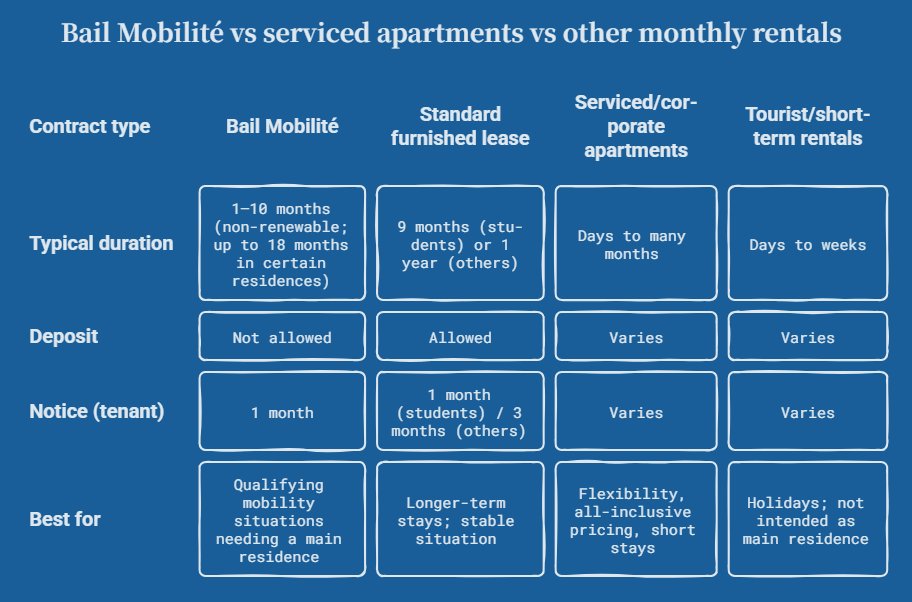
Bail Mobilité vs serviced apartment vs other monthly rentals
Everything must be clear now, but you still need to understand the difference between Bail Mobilité and serviced apartments and other monthly rentals.
How to choose the right temporary accommodation in Paris?
To choose the right short-term rental in Paris, you need to work backwards from your situation, not from the listings:
- Confirm your qualifying reason, training, studies, internship, apprenticeship, civic service, transfer, or temporary assignment and gather the paperwork.
- Be honest about your length of stay, including whether it might stretch past ten months.
- Decide how much flexibility you need to leave early, as Bail Mobilité's one-month notice is one of its biggest advantages for uncertain timelines.
- Check the property and price for compliance, like furnished to the legal minimum, no deposit, rent within Paris's rent-control ceiling if applicable.
- Only then compare arrangements among Bail Mobilité, serviced apartments, and standard leases, against what you've just established.
And you will know whether you qualify for Bail mobilité or need to choose a traditional temporary accommodation.
Where to search for Bail Mobilité listings in Paris
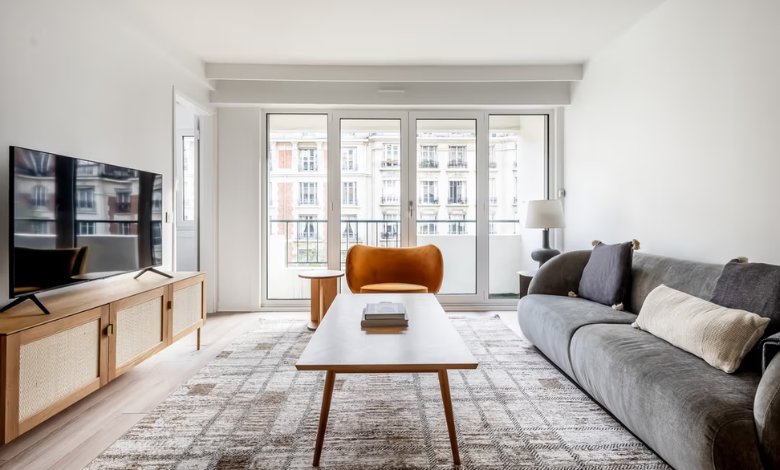
The listings themselves are only half the picture; the tougher part is finding ones already structured correctly, with eligibility, documentation, and lease terms handled properly from the start. At TheSquare, you get Paris Bail Mobilité apartments set up to match the legal framework precisely, so you're not left untangling contract types mid-search.
Browse our Paris apartments for rent short term and filter for your dates. If your situation qualifies for a Bail Mobilité lease, our team can talk you through the paperwork and get you booked in without the back-and-forth.
Practical checklist before signing a Bail Mobilité
Before you sign a bail mobilité lease, you need to ensure everything is as required:
- You have documentation proving your qualifying situation
- The contract explicitly states it's a Bail Mobilité and names your qualifying reason
- The lease term is between one and ten months
- No security deposit is being requested
- You know whether a guarantor is required, and whether Visale is an option
- The property meets the legal furnished-rental furniture list, with a signed inventory at check-in
- Home insurance (fire, explosion, water damage minimum) is arranged before move-in
- You understand the one-month notice process in case you need to leave early
- The rent has been checked against Paris's rent-control ceiling, if applicable
Conclusion: Is Bail Mobilité right for your Paris stay?
Bail Mobilité works well for one specific case: a documented, temporary reason for being in Paris like work, study, training, or transfer. For somewhere between one and ten months, with no interest in tying up cash in a deposit. If that's your situation, it's usually the most straightforward and tenant-friendly contract available.
It's the wrong fit if you're visiting for leisure, if your timeline is open-ended or likely to run past ten months, or if you don't have paperwork to back up your reason for staying.
The contract you sign matters more than the price on the listing. Confirm eligibility first, then search; it's the fastest way to land on the right apartment instead of the right-looking one.
FAQs
Can tourists sign a Bail Mobilité?
Can a bail mobilité be renewed or extended?
What's the difference between a bail mobilité, a bail étudiant, and a standard furnished lease?
What notice period applies to a bail mobilité, and can the landlord end it early?
Can a landlord ask for a security deposit under a bail mobilité?