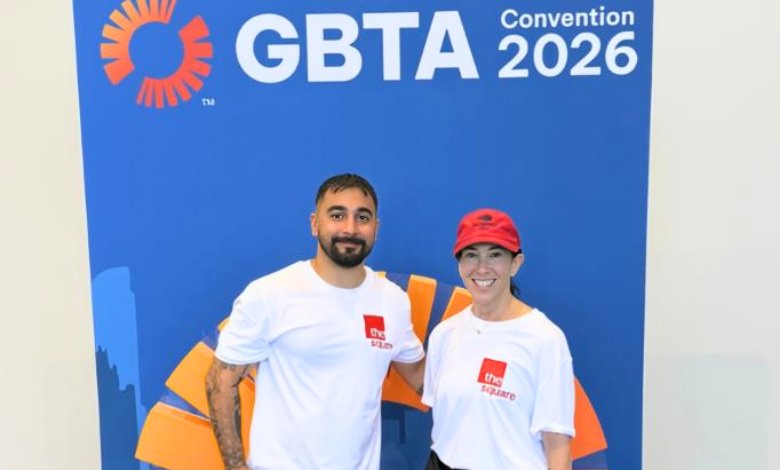
The business travel industry came together in Chicago this August for the 2026 Global Business Travel Association (GBTA) Convention, held at McCormick Place from 3-5 August. The event brought together thousands of people working across corporate travel, including travel managers, procurement teams, accommodation providers, technology companies and other suppliers.
For TheSquare, this year's convention was particularly interesting because conversations about extended stay kept appearing across different parts of the programme. The discussions weren't always specifically about serviced apartments or long-stay accommodation, but many of the issues being raised have a direct connection to how companies accommodate employees who are away from home for several weeks or months.
TheSquare's Mani Sawhney, Business Growth Manager, and Robin Spindel, Head of Marketing, attended the convention as first-time ambassadors for the business. Over three days, they heard from travel buyers, suppliers and other people working across the industry, with three sessions standing out in particular. They looked at stays of 30 nights or more, the challenge of fragmented accommodation rates and the environmental impact of long-term stays.
Together, they offered an interesting view of where extended stay fits into the wider corporate travel landscape. Below we share some of the key findings.
Business travellers staying 30+ nights need more than a hotel room
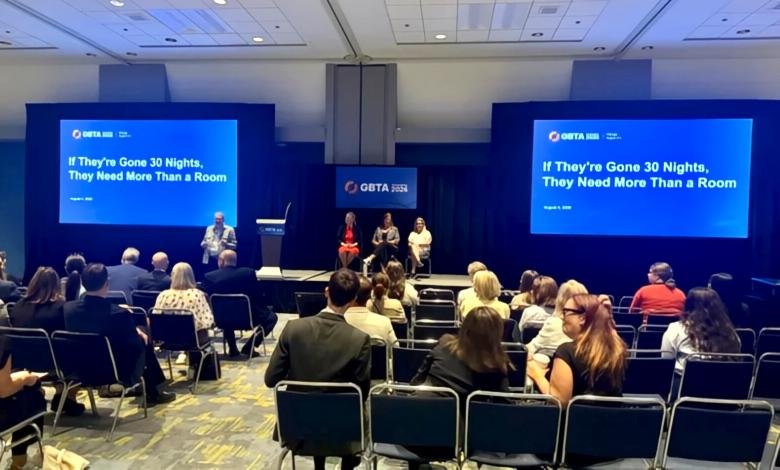
One of the sessions focused on how companies manage stays of 30 nights or more, highlighting just how differently organisations approach longer assignments.
Around half of the room said their organisation doesn't currently have a formal policy covering stays of 30 nights or more. At the same time, travel managers taking part in the discussion reported that their extended stay volumes were growing by between 30% and 50%.
That creates an interesting situation for companies whose travel policies have traditionally been designed around shorter business trips. An employee staying in a hotel for three nights is relatively straightforward to manage through a conventional business travel programme. Once that same employee is away for several weeks or months, the accommodation decision starts to involve other considerations, including employee wellbeing, duty of care, tax, relocation and workforce planning.
One example came from Lazard, the global financial services firm. The company explained that its 30-night threshold didn't always reflect the way its business trips were actually working. In some circumstances, extending a stay beyond 30 nights could unlock a tax benefit, meaning that the most practical decision wasn't necessarily to end the booking at exactly the point the policy suggested.
The example is a useful reminder that a policy based purely on the number of nights doesn't always reflect the circumstances of the person travelling or the needs of the business.
The session also explored how travellers make accommodation decisions. One buyer found that when employees were given more information about their options rather than simply being shown the cheapest rate, they were more likely to choose accommodation that genuinely suited their trip. In that organisation, this approach resulted in savings of around 30%.
Another discussion focused on visibility and duty of care. Oracle, the American technology company, described having to piece together information about employees staying for 30 nights or more, including people who had booked their own accommodation through apartment marketplaces. When an employee is staying somewhere for weeks or months, knowing where that person is staying becomes an important part of being able to support them.
The conversation also highlighted that extended stays aren't limited to traditional relocation scenarios. Large construction projects, including data centre developments, are creating demand for accommodation in smaller markets where the existing hotel supply may not be able to accommodate large numbers of workers for months at a time.
Mani Sawhney shared, “What stood out to us was how closely these different examples connected travel with human resources and workforce mobility. When an employee is away from home for an extended period, the accommodation decision can sit across several different teams, each with a slightly different responsibility. For companies reviewing their approach to longer stays, the question goes beyond what should happen after 30 nights. It is also about whether travel, human resources and mobility teams have a clear process for managing the accommodation throughout the assignment.”
Travellers want choice, but finding the right option matters
Another session looked at a familiar issue faced by corporate travel managers: fragmentation. Companies can negotiate preferred rates with hotels and other accommodation providers, but travellers don't always end up booking those rates or approved suppliers.
Instead, they may use online travel agencies (OTAs) or other booking channels outside of policy.
For a corporate travel programme, bookings made through these channels can make it harder for the company to see where money is being spent and whether employees are using the accommodation options that have already been negotiated.
The discussion at GBTA suggested that this isn't necessarily because travellers are deliberately trying to avoid company policy. Often, they simply can't find what they need through the approved booking process. That distinction is particularly relevant to extended stays.
Someone travelling for two nights may have very different requirements from someone who is going to spend six weeks in the same city. A longer stay might call for a kitchen, separate living and working space, laundry facilities, more privacy and somewhere that feels comfortable enough to live in rather than simply sleep in.
If those options aren't available through the company's usual travel channels, it is understandable that a traveller might look elsewhere.
The session focused on giving employees meaningful choice while keeping that choice within the company's travel programme. Rather than limiting travellers to a small number of options, companies can provide a broader selection that still meets their requirements around cost, quality and policy. Companies can also overcome this with training for their travellers in how to use their tools and why it matters.
Robin Spindel stated: “What struck me most was how consistent the message was across several sessions. Travellers aren't trying to go around the programme; they just can't find what they need inside it. That's exactly the problem TheSquare can solve. For extended stays, we believe this is particularly important. A good accommodation programme shouldn't simply tell an employee where they can stay. It should help them find somewhere that actually works for the length and purpose of their trip, while giving the company the visibility it needs.”
Sustainability is an important factor

Sustainability was another major theme at this year's convention, and the discussions around accommodation raised an important point about the visibility of longer stays.
Around half of long-stay bookings are estimated to take place outside formal corporate travel programmes. When those bookings aren't visible to the company, they can also be missing from its emissions reporting.
This makes it difficult for businesses to understand the environmental impact of their accommodation and, in turn, to identify where changes could make a difference.
The accommodation itself is also part of that conversation. Heating, ventilation and air conditioning (HVAC) account for 45% of the energy used within hotel accommodation. Serviced apartments, which typically include a kitchen and living space alongside the bedroom, carry a much lower carbon emission footprint.
There are practical reasons why this model can make sense for longer assignments too. Travellers often value having more space and privacy, being able to cook for themselves and having access to laundry facilities when they are away for several weeks. Those features can also help someone maintain a more normal routine while they are away from home.
The financial side becomes increasingly relevant as the length of a stay increases. The cost of a hotel room, combined with taxes and the additional expense of eating out, can make serviced accommodation an attractive alternative for longer assignments.
The sustainability discussion at GBTA also highlighted the importance of having better information available when accommodation is being selected. Companies can only make meaningful comparisons if they know what they are booking and have access to information about the environmental impact of the property.
That is one area where we see technology playing a useful role. TheSquare's EcoGrade tool provides property-level emissions information, allowing the individual traveller or company to consider sustainability as part of the accommodation decision.
What does this all mean for companies utilising extended stays?
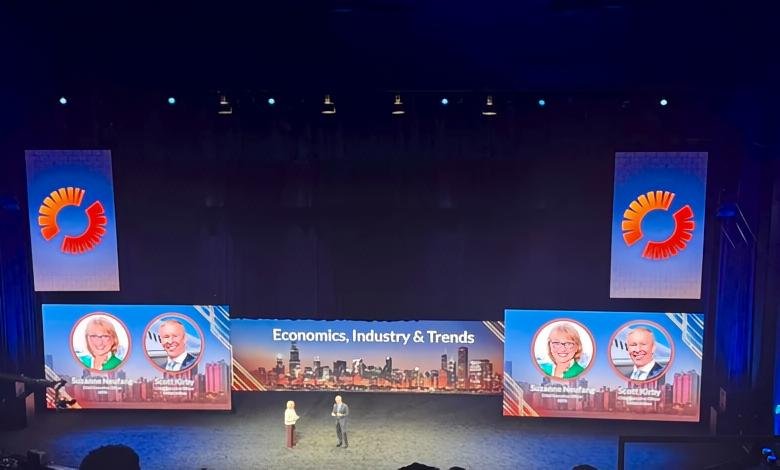
Although the three sessions covered very different subjects, they all pointed towards a similar shift in corporate travel.
Extended stay is becoming a more significant part of the way people travel for work, whether that is because of a project, a relocation, a long-term assignment or a need to support a workforce in a particular location.
At the same time, longer stays don't always fit comfortably within systems that were designed around shorter hotel bookings.
The accommodation may be arranged by a travel team, while the employee's assignment is being managed by human resources or a mobility team. Procurement may be responsible for the commercial relationship, while finance is looking at the overall cost. The traveller, meanwhile, simply needs somewhere that works for them for the duration of their stay.
When those different perspectives aren't connected, it can become difficult to see the full picture.
This is where TheSquare's approach to long-stay accommodation comes in.
TheSquare provides a single platform for sourcing, booking and managing vetted serviced apartments and other long-stay accommodation. Bringing those elements together gives travel, human resources and mobility teams access to the same information while giving travellers a more suitable range of accommodation options.
Our takeaways from GBTA Convention 2026
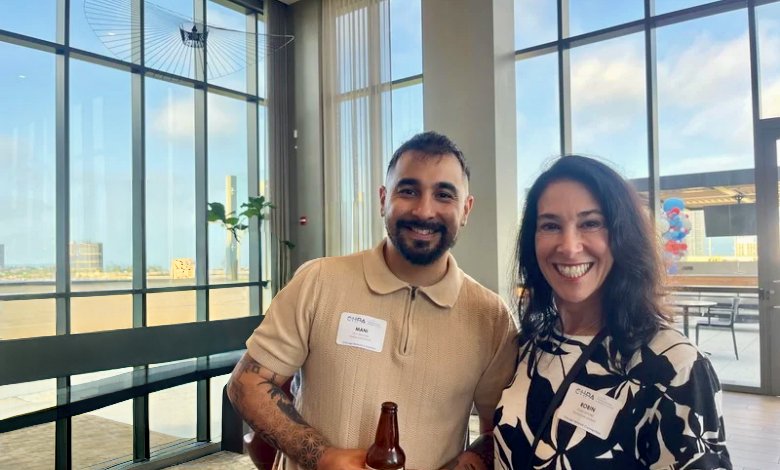
Our first GBTA Convention gave us the opportunity to hear directly from people working across the business travel industry and to understand some of the issues they are thinking about as corporate travel continues to evolve.
For us, the most interesting part was seeing how many of those conversations connected back to extended stay.
Longer assignments can raise different questions around accommodation, traveller experience, cost, duty of care and sustainability. They can also involve several teams within the same organisation, which makes having a clear and consistent approach increasingly important.
Rather than treating extended stays as an exception to the traditional travel programme, there is an opportunity to think about them as a distinct part of corporate accommodation, with options and processes designed around the reality of staying somewhere for weeks or months.
That means giving travellers accommodation that suits the length of their stay while giving the people responsible for the programme the visibility they need.
If you're reviewing your approach to extended-stay accommodation, TheSquare can help. Whether you need accommodation for one employee or you're housing an entire team, we can source suitable serviced apartments and manage the stay from booking through to check-out.