What you'll gain from this blog
- Understand why summer is the best time to relocate to Singapore.
- Learn the latest Singapore relocation and visa updates for 2026.
- Plan your move with a simple relocation timeline and checklist.
- Estimate the 2026 cost of living and key expenses.
- Compare housing options and the best neighbourhoods for new arrivals.
- Discover practical tips for a smooth, stress-free move to Singapore.
Whether you are moving to Singapore for a new job, relocating with your family, or starting a new chapter abroad, summer is one of the busiest times of the year.
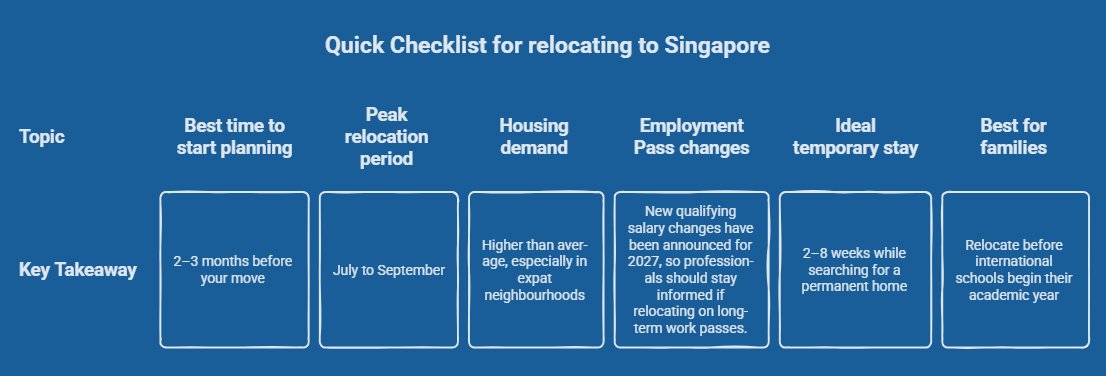
The reason being thousands of professionals, students, and expat families arrive between July and September, aka summer. Hence turning this time period into one of the most competitive ones for housing, relocation, as well as school admissions.
If you're planning your move in 2026, this guide will walk you through the whole process. Beginning with understanding what to expect, preparing early and practical, lived-in details that can make the difference between a stressful relocation and a smooth transition.
Quick Checklist if you are relocating to Singapore this summer
If you're relocating to Singapore this summer, here's what you should know:
Why Is Summer the Most Popular Time to Relocate to Singapore?
Singapore's relocation patterns are mostly driven by education and employment trends rather than weather.
1. International Schools Begin a New Academic Year
Most of Singapore's leading international schools welcome students in August. Leading to families relocating from the UK, Australia, Europe, Asia and North America to plan their move to Singapore during the summer holidays.
As a result, demand for family-friendly accommodation tends to increase from July onwards.
2. Companies Schedule Mid-Year Relocations
Many multinational organisations align international transfers with new financial quarters, regional expansion plans, leadership changes, graduate recruitment cycles, and project launches.
Singapore is a beacon for Asia’s leading MNCs' headquarters, turning it into a popular destination for expats and professionals. It has been reported that Singapore’s labour market has continued to grow.
3. More People Are Choosing Singapore
Living in Singapore has been a dream for young talent and is still continuing, thanks to political stability, a strong economy, world-class healthcare, international education, and strong regional connectivity.
The sustained demand can be supported by Singapore's Ministry of Manpower numbers; the country had over 1.63 million foreign workers at the end of 2025, including more than 203,000 Employment Pass holders, highlighting its role as a global business hub.
What's New for People Relocating to Singapore in 2026?

It's best to know what is new about moving to Singapore in 2026 if you are planning a move this year.
Employment Pass Policies Continue to Evolve
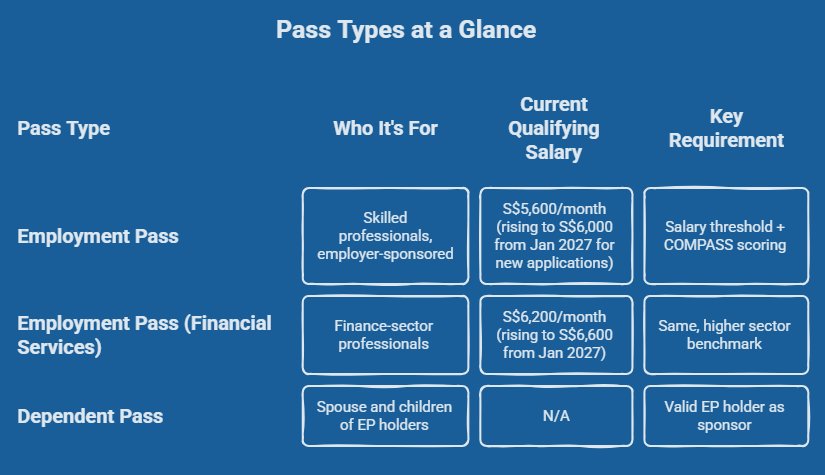
Singapore regularly reviews Employment Pass requirements to ensure foreign professionals complement the local workforce. In 2026, the government increased the minimum qualifying salary for new Employment Pass applications from S$5,600 to S$6,000 from January 2027.
These changes will not affect you if you are moving to SG in summer 2026, but they are still important if you are planning a long-term career here.
Housing is Stabilising, but Planning Still Matters
Rental prices have become more stable compared with the sharp increases seen in previous years, but demand remains high in popular expat neighbourhoods, especially during the July-September window.
Areas such as Orchard, River Valley, Holland Village, etc, often get sold out during this time period. If you've planned a move to Singapore without choosing a long-term neighbourhood yet, many relocation experts recommend staying in flexible, fully furnished accommodation for your first few weeks.
How to Relocate to Singapore: A Step-by-Step Timeline
You must be wondering how to manage such a big move. What are the steps? First of all, do not wait till your visa is approved to plan accommodation and other details. Here is a step-by-step timeline on how to relocate to Singapore.
- 8-12 weeks before: Accept your offer, begin the work pass process, and start researching neighbourhoods in earnest.
- 6-8 weeks before: Arrange temporary accommodation, compare international schools if you have kids, and organise shipping for anything you're bringing.
- 4-6 weeks before: Book flights, prepare key documents, and understand your healthcare/insurance options.
- 2 weeks before: Confirm arrival logistics, banking requirements, and SIM card options so day one isn't spent figuring these out from scratch.
- First month: Explore neighbourhoods in person, view long-term rentals, complete local registrations, and settle into a routine.
What are The Singapore Visa Requirements in 2026?

As you plan or think about moving, it is important to be clear about Singapore’s Visa requirements in 2026. For relocating to Singapore, you need to either have an Employment Pass or a Dependent Pass.
Employment Pass (EP)
The Employment Pass allows foreign professionals, managers, executives, and technicians to work in Singapore, with candidates currently needing to earn at least $5,600 a month. For the financial sector, the employment pass asks for a minimum salary of S$6,200/month.
It's employer-sponsored, and you can't apply independently. Applications are also assessed against the COMPASS points-based framework alongside the salary threshold.
Dependent Pass
If you're bringing a spouse or children, they'll typically need a Dependent Pass, usually processed alongside your own EP application. Confirm timing with your employer early, since school enrolment sometimes requires proof of pass status.
Check out the table to understand the visa requirements for moving to Singapore.
What is the Cost of Living in Singapore in 2026?
So, what is the cost of living in Singapore in 2026? This is the key question that comes up when anyone plans a move to the city. Singapore consistently ranks among the most expensive cities in the world for expats, but "expensive" isn't the whole story. How expensive it is for you depends heavily on lifestyle choices, especially around housing.
Here is a detailed breakdown of the cost of living to remove any surprises as you plan to relocate.
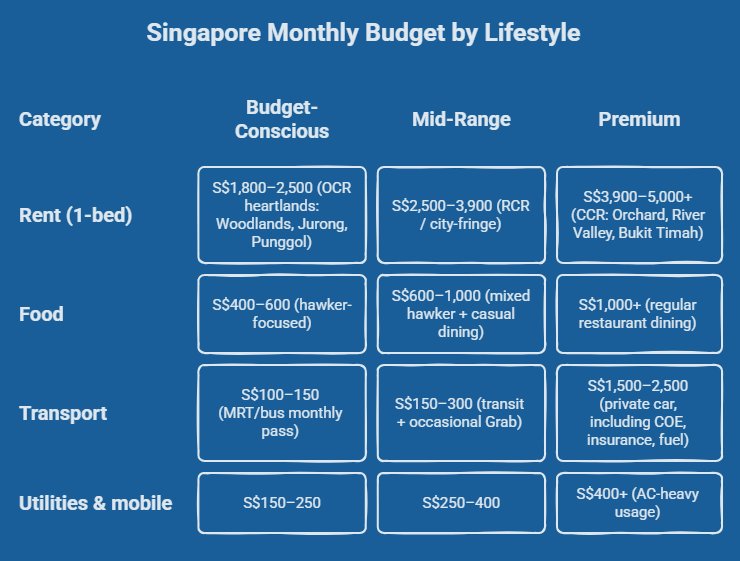
Add these up, and total monthly spend for a single professional typically lands somewhere between roughly S$3,000 on a tight budget and S$5,000+ living comfortably in a central location, before rent-free extras like savings or discretionary spending.
Single Professional vs Family Budget
Family budgets run substantially higher, and the gap isn't really about groceries — it's driven almost entirely by two things: larger housing (a 3-bedroom condo commonly runs S$4,500 a month and up, roughly double a 1-bedroom) and international school fees, covered below.
Hidden Costs to Budget For
- Certificate of Entitlement (COE): The single biggest surprise cost for anyone considering a car is COE. COE premiums for standard cars have been above S$120,000, with larger cars (Category B) above S$129,000. Most expats skip car ownership entirely and rely on the MRT/bus network plus Grab.
- International school fees: Annual tuition typically runs from around S$15,000 at more affordable schools to over S$45,000–55,000 at premium British, American, and IB institutions, and fees generally rise 3–5% a year.
- Rental deposits and agent fees: A security deposit of one to two months' rent is standard, and agents commonly charge tenants half a month's commission on longer leases in Singapore.
- Healthcare and insurance: Private international health insurance typically runs S$1,000–3,000 a year per person. Public polyclinic visits are inexpensive, but private specialist consultations run S$80–150 per visit.
- Air-conditioning: Genuinely not optional given the climate, and a meaningful driver of the utilities range above.
Living in Singapore: Temporary Accommodation & Where to Stay
So how does living in SG look when it comes to accommodation? The housing industry in this country works differently. It is important to understand how to navigate it, especially during a major relocation
Housing Types & How Renting Actually Works in Singapore
Singapore's rental market runs on three distinct housing categories. HDBs (public housing) are the most affordable, but foreigners typically can't rent one directly without meeting specific eligibility conditions.
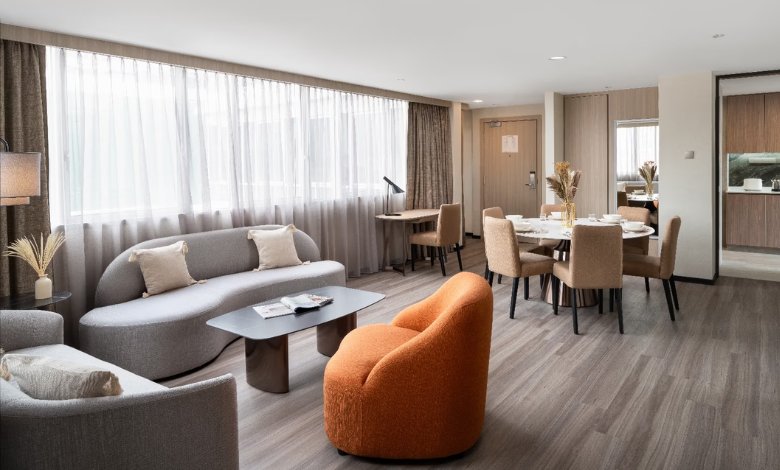
Condominiums are the default choice for most expats with amenities like pools and gyms, across a wide price and location range. Lastly, serviced apartments are fully furnished with hospitality-style services and flexible, short-term leases, being increasingly used as the bridge between landing and signing a permanent lease, rather than just for short business trips.
Once you know which type fits, the renting mechanics are largely the same across the market. Most condo and HDB leases run a minimum of 12 months with a one- to two-month deposit; in-person viewings matter, since photos rarely capture everything.
Why Temporary Accommodation in SG Makes Sense for New Arrivals
Since leasing HDB or a condo requires a lot of work, it is best to go for serviced apartments while moving to Singapore. Choosing a fully furnished apartment for the first few weeks provides flexibility while you settle into your new routine.
Many professionals spend their first few weeks viewing different neighbourhoods, waiting for family members to arrive, completing employment formalities, understanding commuting times and comparing long-term rental options.
Hence, temporary accommodations allow you to explore different neighbourhoods before you decide on one. Many families and expats moving to Singapore feel these serviced apartments make the whole process easier and more comfortable.
Where to Stay: The Neighbourhoods, and Why Summer Timing Matters
These temporary serviced apartments cover where to stay right away. But where you stay in Singapore when you relocate is just as important, as it shapes your commute, budget, and other factors of daily life in the city.
- Orchard Road, River Valley, Tanjong Pagar: Orchard Road, River Valley, and Tanjong Pagar are Central, high-demand, and among the fastest-booking areas between July and September. If you want a central unit, act early in the season.
- Holland Village, Bukit Timah: Popular with families for proximity to international schools, Holland Village, Bukit Timah is a great option.
- East Coast: Coastal, family-friendly, and slightly more affordable than the city core, though East Coast still sees faster summer bookings than the rest of the year.
- Tiong Bahru, Queenstown: City-fringe, walkable, and increasingly popular with younger expats and professionals. Tiong Bahru and Queenstown offer Art Deco architecture, a strong café scene, and a shorter commute into the CBD than pure OCR options, at a real price step down from CCR.
- Punggol, Sengkang, Woodlands, Jurong: These areas offer the best value for space and newer housing stock, with longer commutes to the CBD but generally far less pressured by the summer rush. A solid fallback if central options are already booked out, and often the better fit if you're prioritising space over commute time.
You can check out our detailed guide to where to stay in Singapore and make your move easier.
Make your move to Singapore easier with TheSquare
Once you tick off everything we have laid down here, you will be ready to move to Singapore. You can make the journey easier by choosing TheSquare for booking serviced apartments for your move.
Are you moving to Singapore and still figuring out the best base? Get in touch with us at stay@thesqua.re, and we'll help you find the right serviced apartment in Singapore when you relocate.
FAQs on Moving to Singapore in Summer
Is it worth moving to Singapore as an expat?
What are the biggest downsides of living in Singapore?
What salary do I need to live comfortably in Singapore?
Do foreigners pay income tax in Singapore?
Is Singapore better than the US, UK, or Australia for expats?