
What You’ll Gain from This Blog
- Key changes under Awaab’s Law Phase 2 from 30 November 2026.
- The seven additional hazards covered by Phase 2.
- Investigation, reporting and repair deadlines for housing providers.
- Challenges in arranging suitable alternative accommodation.
- The risks of non-compliance and delayed repairs.
- How TheSquare supports emergency accommodation for displaced tenants.
Awaab’s Law came into force for the UK social rented sector on 27 October 2025. It is named in memory of Awaab Ishak, a two-year-old boy who died after prolonged exposure to mould in his family’s home. Since that date, social landlords have been required to deal with emergency hazards, and with damp and mould that pose a significant risk to tenants, within fixed timeframes.
From 30 November 2026, the second phase will extend the requirements to seven more hazards and place increased pressure on resolution time limits. This means that housing associations will have to abide by even tighter requirements to keep tenants safe in their accommodations.
They will need to identify hazards and have a clear process to deal with repairs. If the tenant's home does not meet the requirements, the housing association must provide alternative accommodation. There will be significant consequences for housing providers if they fail to protect the tenants and meet statutory deadlines.
This article covers what changes with Awaab’s Law Phase 2, the implications for housing providers and their accommodation partners. And what steps they can take to prepare for the deadline in November.
What changes with Phase 2?
The law is set to be implemented in three phases. From 30 November 2026, Awaab’s Law will be extended to the following hazards where they present a significant risk of harm:
- excess cold
- excess heat
- falls on the level (including falls on the level, falls on stairs, etc., falls between levels)
- structural collapse
- fire and explosions
- electrical hazards
- domestic hygiene (including personal hygiene and food safety)
Phase 3 will extend regulations to all remaining HHSRS hazards (apart from overcrowding) where they present a significant risk of harm.
For housing associations, this means preparing for broader requirements: identifying hazards, possible or underlying, and responding promptly to ensure tenants' utmost safety.
Timeframes
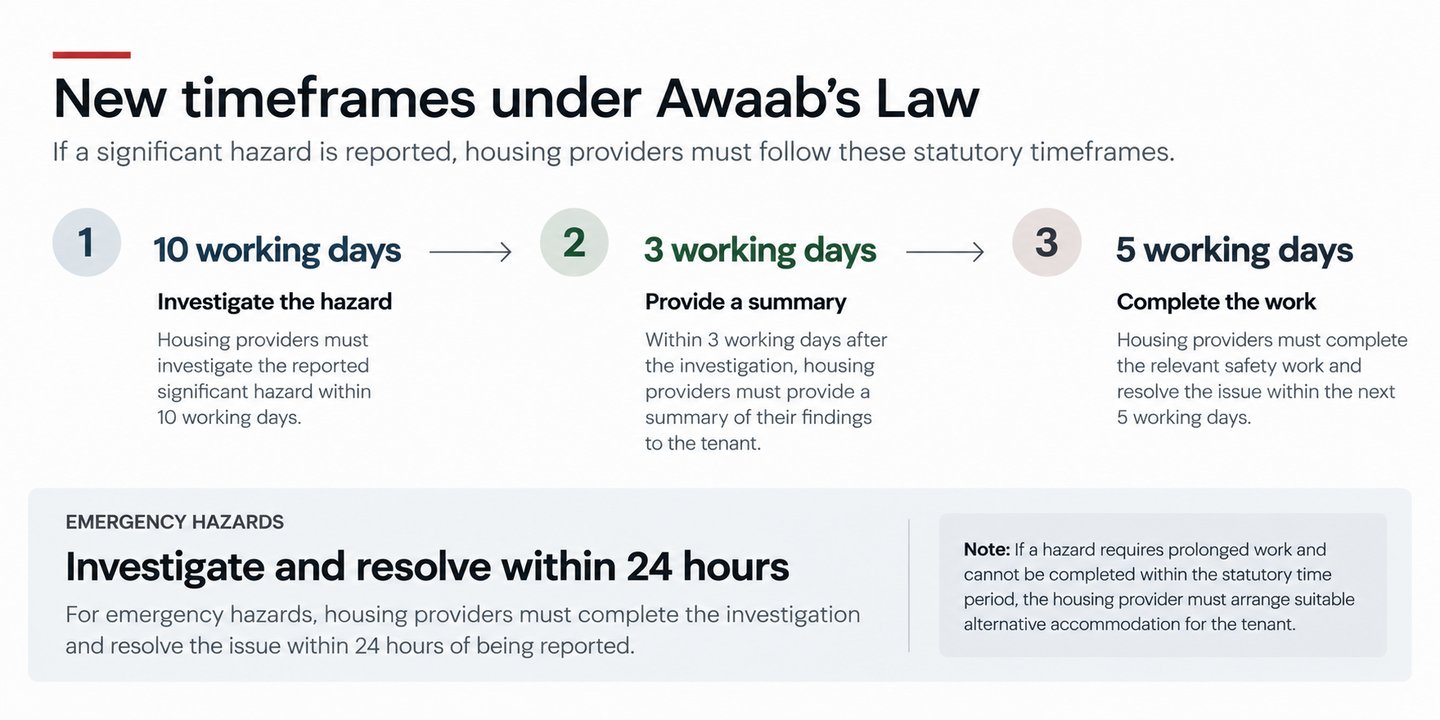
If a significant hazard is reported, housing providers have 10 working days to investigate, 3 working days after that to provide a summary, and the following 5 working days to complete work and solve the problem.
This does not apply to emergency hazards, which require housing associations to finish investigation and solve issues within 24 hours of being reported.
If a hazard requires prolonged work or time and can not be completed within the given time period, the housing provider is responsible for securing another suitable accommodation for the tenant. The association must cover this, and the new accommodation must also be suitable under Awaab’s Law.
Challenges for housing providers
Awaab’s Law increases the pressure on housing providers by emphasising timely action, accountability and keeping the residents informed. Let’s understand it in detail.
- Speed: Finding a suitable place at short notice is hard, especially with the 24-hour clock running from when the landlord becomes aware of the hazard. Many associations don’t hold spare stock or a standing temporary move arrangement.
- Suitability: The accommodation has to fit the household (size, disability, children, pets, proximity to schools or work). A hotel room may be fine for one night but not for a family or for a stay of several weeks.
- Duration and cost: The cost falls on the landlord, and the stay length depends on how long the repair takes. That is hard to forecast and sits uneasily with already stretched budgets. Resources are a concern for housing associations at a time when their finances are being stretched.
- Competition for supply: Associations are looking for temporary housing in the same market as local authorities with homelessness duties, which pushes up costs and limits availability.
- Vulnerable residents: Moving elderly, disabled or very young residents at short notice is difficult to do well.
- Coordination: Repairs, housing management, customer service and the accommodation provider all have to work together fast, usually outside office hours.
How TheSquare helps Social Housing Associations

A reliable temporary accommodation provider like TheSquare helps housing associations to meet the requirements of Awaab’s Law, coordinate alternative housing within the time constraints, while at the same time, protecting the tenants. We manage accommodation sourcing, coordination and ongoing resident support, helping housing providers arrange suitable alternative housing quickly.
How we respond rapidly and at a huge scale was demonstrated when a fire safety evacuation in Canary Wharf displaced 400 residents. TheSquare secured more than 200 serviced apartments within four hours to help a social housing association. The emergency accommodation that met the regulations was arranged within the time limit.
You can explore the case study here or contact us to learn about how we’ve supported many other housing associations to be compliant, relieving the burden and liability exposure.
Preparing for Awaab’s Law Phase 2
With Phase 2 of Awaab’s Law being implemented on 30 November 2026, housing associations need to prepare in time to respond to hazards within set timelines and stay compliant. Partnering with serviced apartment providers like TheSquare can help when repairs take long, and tenants need to be shifted to suitable alternative homes.
Talk to TheSquare team to explore emergency accommodation options that fulfil safety compliance and prepare for Phase 2.
FAQs
What is Awaab’s Law Phase 2 and when does it come into effect?
Which hazards are covered by Awaab’s Law Phase 2?
What are the repair deadlines under Awaab’s Law Phase 2?
When must housing associations provide alternative accommodation under Awaab’s Law?
How can housing associations prepare for Awaab’s Law Phase 2?